


Thin, sterile needles go directly into the knotted muscle tissue causing the problem. That’s the short version. Trigger points keep the muscle locked short, and that constant tension compresses structures around the joint and sends pain into the upper arm and neck. Once those knots release, the muscle length normalises and the nerve signals driving the pain settle with it. So the shoulder doesn’t just feel better. It starts moving properly again.
Most shoulder pain treated with dry needling has a muscular or myofascial component underneath, even when imaging doesn’t always show it clearly.
According to the physiotherapy team at Back to Ease in Bayswater, “Dry needling gets to muscle tissue that hands can’t always reach. For shoulder pain with deep, stubborn knots, it’s often what shifts things when other techniques haven’t fully done the job.”
What Actually Happens During Dry Needling for the Shoulder?
The process is more specific than most people expect. It’s not placed anywhere near the shoulder and left.
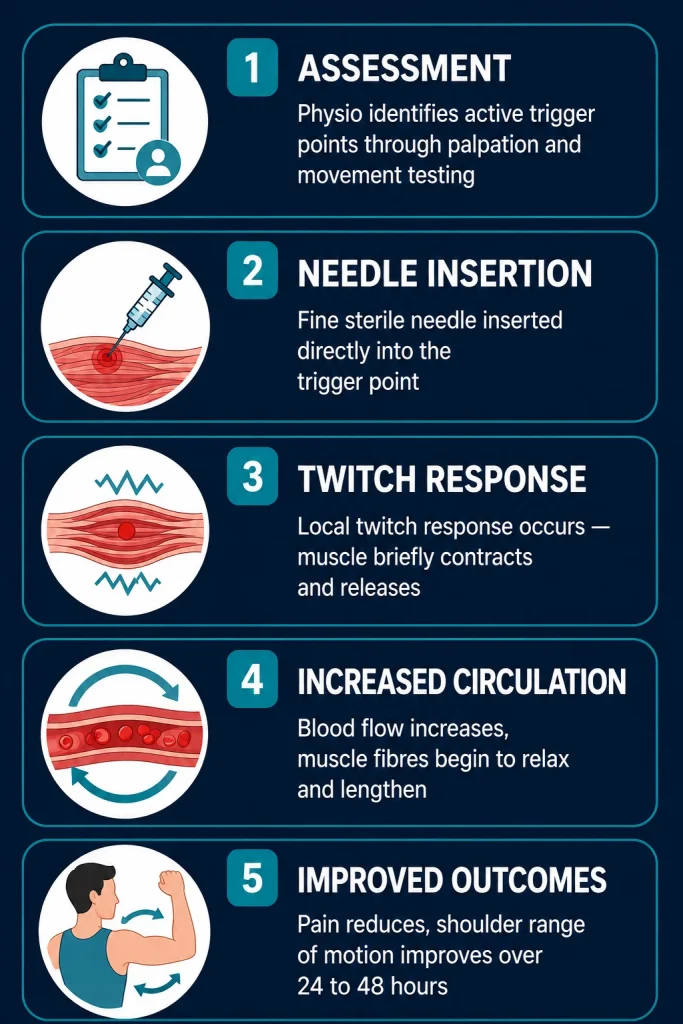
Each needle goes into a specific location your physio has already mapped through palpation. When it hits a trigger point, the muscle twitches. That’s not incidental. It’s the tissue releasing the tension it’s been holding, often for weeks or months. A 2024 PMC systematic review on overhead athletes with myofascial shoulder pain found dry needling reduced pain and improved upper limb function, particularly when paired with exercise. The shoulder has several overlapping muscle layers, rotator cuff, upper trapezius, infraspinatus, and a single session can work across more than one of them depending on what the assessment finds.
But it’s never standalone. Physio-guided dry needling sits inside a broader plan — it opens the door for rehab work that wouldn’t land as well on tissue that’s still locked up.
Which Shoulder Conditions Respond to Dry Needling?
Not every shoulder complaint fits. But several presentations respond consistently when trigger points are contributing to the pain.
- Rotator cuff pain: When the supraspinatus, infraspinatus, or subscapularis stays shortened and tight, it pulls the joint out of alignment. Needling these muscles takes load off the tendon and lets the joint mechanics settle in a way that exercise can’t achieve while the tissue is still restricted.
- Shoulder impingement: When the muscles around the shoulder compress the structures above, range of motion drops and certain movements become sharp and painful. Releasing the overactive muscle groups through dry needling takes that compression off and gives rehab exercises room to actually work.
- Neck-referred shoulder pain: The upper trapezius and levator scapulae refer pain into the shoulder and upper arm more often than people realise. The shoulder gets blamed for something that started higher up. Needling the actual source, not the site of symptoms, is what resolves it.
- Post-sport or repetitive strain: Overhead athletes and people doing repetitive upper limb work accumulate trigger points that don’t clear with rest alone. Dry needling clears the backlog of muscular tension so the shoulder can load again without immediately flaring.
For more on how dry needling compares to other needling approaches, the dry needling treatment blog breaks down the key differences clearly.
Why choose Back to Ease Physiotherapy?
Back to Ease is a physiotherapy clinic in Bayswater with experience treating shoulder pain, myofascial restriction, and trigger point presentations across a range of patients. Shoulder cases here don’t get a generic routine. The assessment determines which muscles are driving the pain, which are compensating, and in what order they need to be addressed.
Targeting the right muscle at the right stage, paired with the right exercise, is what produces lasting change rather than temporary relief. Most patients notice a real difference within a few sessions once the source of the pain, not just the symptoms, is being treated.
Frequently Asked Questions
How long does a dry needling session take for shoulder pain?
Usually 20 to 40 minutes, varying with how many areas need to be addressed.
Does dry needling hurt?
A brief twitch or ache is normal and fades once the needle comes out.
How many sessions are needed for shoulder pain?
Most people notice change within two to four sessions, depending on the cause.
Is dry needling safe for all shoulder conditions?
Not always. A physio assessment determines whether it’s appropriate for your case.
Disclaimer :
This blog is for educational purposes only and is not a substitute for professional advice. Please consult a certified physiotherapist for diagnosis and treatment specific to your condition.